The CMO of a Series B fintech company once cornered me at a conference and told me their deliverability was "broken." Their open rates had dropped four points over six weeks. Her solution, recommended by an outside consultant: switch HubSpot to a HubSpot dedicated IP. The cost would be significant. The deliverability lift, she'd been promised, would be transformative. The problem: her sending volume was 35,000 emails per month. Moving to a dedicated IP at that volume would have actively hurt her deliverability, possibly for months, and she would have paid for the privilege.
In my experience, dedicated IP is the most over-recommended fix in HubSpot deliverability. It's a real tool with a real use case, and that use case applies to roughly 10% of the HubSpot accounts that ask about it. The other 90% would be better served by leaving the IP question alone and fixing the things that actually broke their numbers.
What "shared IP" actually means in HubSpot
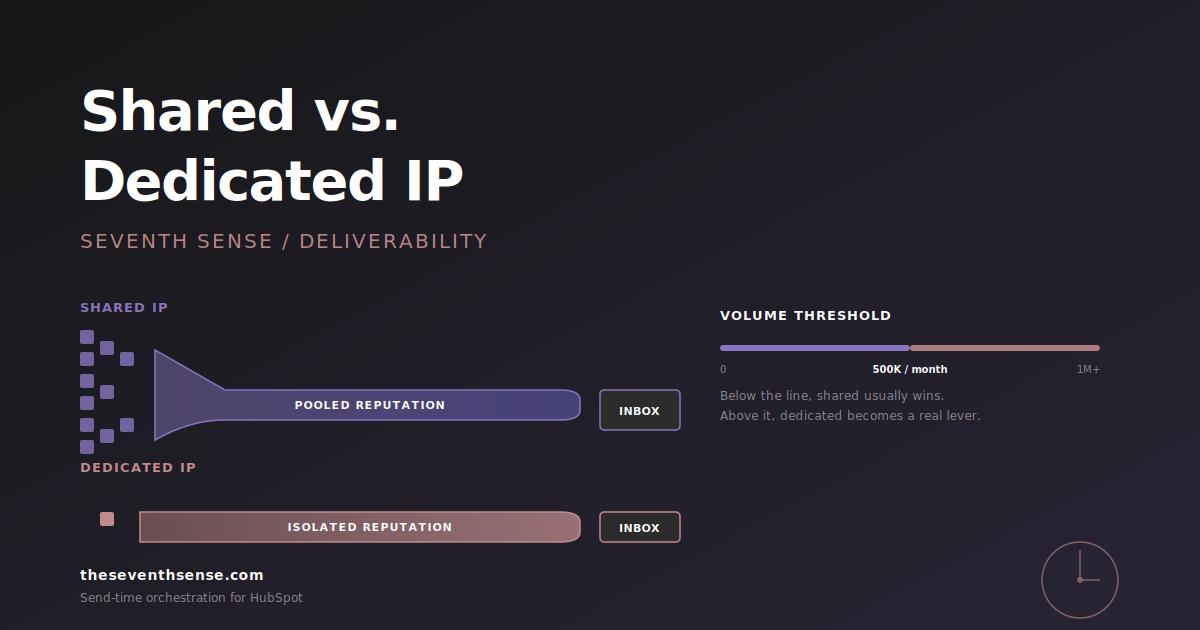
By default, HubSpot sends your marketing email from a pool of IP addresses that are shared across many HubSpot customers. The reputation of each IP is determined by the aggregate behavior of everyone sending from it. Your sends contribute to the IP's reputation, and the IP's reputation contributes to your placement.
The mental model most marketers form is "this is bad because someone else's bad behavior could hurt me." That mental model is wrong in two ways. First, HubSpot actively segregates senders by reputation - high-engagement, well-authenticated senders are routed through higher-quality IP pools, and bad actors are routed elsewhere or removed. Second, even if your pool has the occasional bad neighbor, the reputation of a well-managed IP pool with thousands of senders is much harder to damage than the reputation of a single dedicated IP with one sender.
Shared IPs benefit from scale. That's not a marketing line; it's how mailbox provider trust works. Gmail trusts an IP that sends 50 million high-engagement messages per month from a stable, well-managed pool more than it trusts a dedicated IP from a single mid-market company sending 200,000 - this is consistent with how Google describes IP reputation in its sender guidelines.
What "dedicated IP" actually means
A dedicated IP is an IP address used only by your sends. HubSpot offers this as an add-on. Your sender reputation is now yours alone - for better and for worse. You don't share with neighbors. You also don't benefit from the pool's aggregate reputation.
The trade is real. If you send enough volume, with high enough engagement, the dedicated IP builds a reputation that's specific to your brand and protected from anything happening on shared pools. If you don't send enough volume, your IP never accumulates enough sending history to establish a reputation, and you sit in the no-man's-land of "unknown sender" forever.
The volume threshold that actually matters
Industry guidance varies wildly on this. The honest answer, calibrated against what we see in our deliverability audits and what mailbox providers actually need to evaluate an IP:
- Under 100,000 sends per month: stay on shared. Your volume is too low to build dedicated IP reputation. You'll lose more than you gain.
- 100,000 to 500,000 sends per month: consider dedicated only if you have engagement problems specific to your sender, not your pool. If your shared-pool deliverability is fine, leave it alone.
- 500,000+ sends per month: dedicated starts to make sense, especially if engagement is high and you've outgrown the shared pool's reputation ceiling.
- 1,000,000+ sends per month with consistent volume: dedicated is usually the right answer, and warming is a manageable project.
These aren't hard cutoffs. They're directional. The thing they're all measuring is the same question: do you send enough volume, often enough, to give mailbox providers a stable signal about who you are? If the answer is yes, dedicated lets you control that signal. If no, you're better off in a pool that has the signal already.
When dedicated IP actually wins
There are three situations where dedicated IP is clearly the right move:
1. You have specific reputation risk you need to isolate
If you're in an industry where your sender reputation is unusually exposed - political fundraising, certain financial categories, gambling, anything with frequent complaint rates - the shared pool may either reject you or filter you. A dedicated IP gives you isolation and accountability for your own behavior.
2. You send high enough volume to build and maintain reputation
Once you're consistently sending 500K+ per month, your sender behavior is enough to define an IP's reputation on its own. At that point, the dedicated IP becomes an asset you can manage actively - warming new sending patterns, isolating campaigns, separating different sender personas.
3. You're running multiple programs with different risk profiles
If your transactional emails (account creation, password resets) need to be insulated from any reputational drift in your marketing email, splitting them onto a dedicated IP for transactional and leaving marketing on shared (or another dedicated) is the cleanest separation.
When shared IP actually wins
The cases where shared is clearly better - and where dedicated is a downgrade:
Low or inconsistent volume
If you send 30,000 emails one month and 200,000 the next, the dedicated IP never establishes a stable signal. Mailbox providers see erratic sending, and erratic sending reads as suspicious. The shared pool absorbs this variance because the pool's overall pattern is stable.
Engagement is your real problem, not isolation
If your open rates are dropping because your list quality has decayed or your content is missing, moving to a dedicated IP makes the same problem more visible, not less. Your engagement-based reputation is now entirely yours, and there's no shared pool to absorb the bad signal. You'll see deliverability get worse before it gets better, and "better" requires fixing the underlying engagement issue.
You're a fast-growing company
If your sending volume is doubling every six months, a dedicated IP that you warmed up at last quarter's volume can't handle this quarter's volume without re-warming. Shared pools scale with you automatically. Dedicated IPs require active warming management every time your volume steps up.
What "warming" actually requires
Warming is the single most under-explained part of moving to dedicated IP. The marketing pitch is "we'll get you set up in a week." The reality is six to twelve weeks of carefully managed volume ramping before the IP has a real reputation - broadly consistent with the industry warming guidance the Messaging, Malware and Mobile Anti-Abuse Working Group (M3AAWG) publishes.
A standard warming schedule looks like this:
- Week 1-2: send no more than 5,000 emails per day, exclusively to your most engaged segment (opens in the last 30 days).
- Week 3-4: increase to 15,000-25,000 per day, still skewed to engaged contacts.
- Week 5-8: gradually expand to your full active list, watching engagement and complaint rates daily.
- Week 9-12: stabilize at full volume, monitoring for any reputation events that need response.
If you can't commit to this kind of segmented warming schedule, dedicated IP isn't going to work for you regardless of your volume. Skip the warming and you'll establish your IP's reputation by burning it.
The principle most marketers miss
Here's the principle: dedicated IP isn't a deliverability fix. It's a deliverability lever you earn through sending volume and content quality. Reaching for it because your numbers are bad is like buying a faster car to fix a navigation problem. It doesn't address the cause, and now you have additional things to manage.
The dedicated IP question should be downstream of the engagement question, not upstream. If your engagement is poor, fix engagement on shared first. If your shared engagement is great and you're hitting volume thresholds, dedicated becomes a real option.
Where Seventh Sense fits in
The work we do on recipient-level send-time optimization and recipient-centric orchestration affects deliverability in a way that's largely independent of the shared/dedicated question. Whether you're on a shared HubSpot IP or a dedicated one, sending at recipient-specific times to engaged contacts produces stronger engagement signals than batch sends at fixed times to a broad list.
In our experience, customers who are considering dedicated IP often see their engagement problem resolve through better send-time and orchestration discipline - which means they no longer need the dedicated IP they were about to buy. The Campaign Orchestration we shipped in February 2026 and the Over-Messaging Tracker from April 2026 both target the underlying engagement and over-messaging issues that get misdiagnosed as IP-level problems.
Frequently asked questions about HubSpot dedicated IP
Does HubSpot recommend dedicated IP for everyone?
No. HubSpot offers dedicated IP as an add-on and explicitly recommends it for high-volume senders with consistent sending patterns. For most accounts, HubSpot's documentation correctly advises that shared IPs offer better deliverability through pooled reputation.
How long does dedicated IP warming take?
Six to twelve weeks for a properly managed warming process. Compressed warming is possible but increases the risk that the new IP gets flagged as suspicious before establishing a baseline.
If my deliverability is bad, will dedicated IP fix it?
Only if the cause of the bad deliverability is your shared pool, which is rare. Most deliverability issues come from list quality, engagement decay, or content patterns - and dedicated IP makes those problems more visible, not less. Fix the underlying issue on shared first.
Can I send transactional and marketing email from the same dedicated IP?
You can, but it's not best practice. Transactional and marketing have different engagement profiles, and combining them on one IP averages the reputation. Separating them - either onto two dedicated IPs or transactional on shared and marketing on dedicated - produces cleaner signals.
Where to go from here
Before you ask about dedicated IP, ask whether your engagement is healthy enough to justify it. Calculate your average monthly volume. Look at your 30-day engagement segment as a percentage of your active list. Look at your unsubscribe and complaint rates. If those numbers are healthy and your volume is at or above 500K per month, dedicated is worth exploring. If any of those are weak, fix them first.
The free trial of Seventh Sense includes the engagement and over-messaging diagnostics that tell you whether your real problem is IP-level or behavior-level. Most of the time, what looks like an IP problem is a send-pattern problem with a much cheaper fix.
Dedicated IP is a tool. Make sure you need it before you buy it.
See what your email program could be doing.
Connect Seventh Sense to your HubSpot portal and watch the AI surface per-person engagement profiles, per-inbox-provider performance, and AI-driven optimization recommendations - within 24 hours.
Try it free →